PUBLICATIONS
After Liberation: Women and the Politics of Expectations in Rebel-to-Party Transitions
Available here
War offers opportunities for women to liberate their communities and build a better life for themselves. When women join rebel groups, they often take on new roles, cultivate new social networks, and develop new skills. These rebel women often gain the respect of rebel leaders, their comrades-in-arms, and the communities they're fighting for. When the guns are silenced, however, women have struggled to maintain the progress and prestige that they gained during war. Hilary Matfess investigates the gendered legacies of conflict and considers why it is so difficult for female veterans to defend the gains they made during war.
This book explores how both individual female veterans and former-rebel political parties balance the incentives to continue their wartime activities or moderate them to succeed in the post-war period. The particular balance struck—by party elites and by female veterans—shapes women's rights and representation after war. Drawing on cross-national statistics and in-depth qualitative case studies of rebel groups—from Ethiopia, Namibia, El Salvador, and Nepal—Matfess advances a theory to explain the post-war legacies of women's participation in rebellion at both the individual and the organizational levels. This book helps us understand why women that were once lauded as the backbone of the revolution are so frequently relegated to the backburner after war.
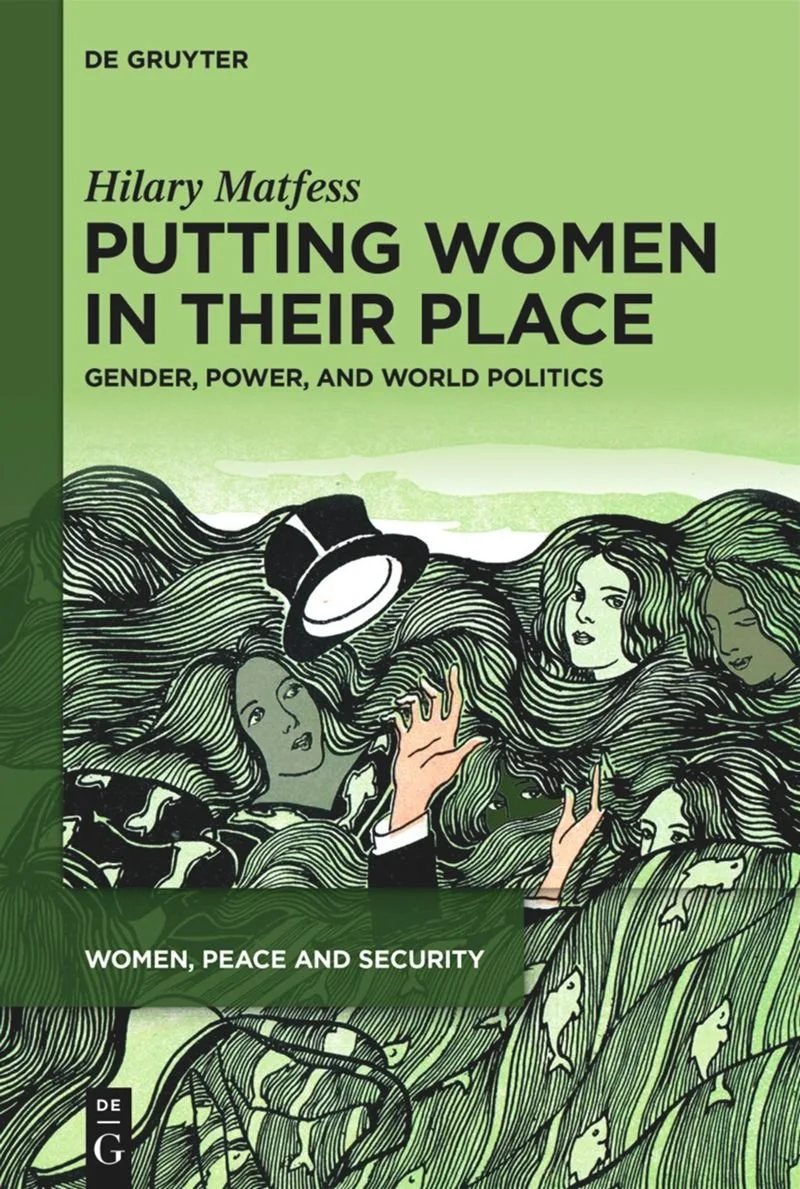
Putting Women in their Place: Gender, Power, and World Politics
Available here
The subordination of women to men is a powerful but invisible force that shapes international politics, economics, and security. Putting Women in their Place centers these lopsided power dynamics to examine how gender hierarchy both drives international dynamics and conditions how men and women experience things.
By critically assessing the ways gender norms shape political decision-making, economic development and financial disparities, and violence and conflict, Hilary Matfess expertly explains complex concepts and provides a compelling, approachable framework for interpreting global politics. This book weaves together personal stories, policy analysis, and the latest research to reveal the intertwining nature of gender oppression and systems of power, from local communities to the United Nations. It also offers a roadmap for rethinking world affairs through a feminist lens that foregrounds women’s agency, individuality, and varied motivations.

Women and the War on Boko Haram
For over a decade, Boko Haram has waged a campaign of terror across northeastern Nigeria. In 2014, the kidnapping of 276 girls in Chibok shocked the world, giving rise to the #BringBackOurGirls movement. Yet Boko Haram's campaign of violence against women and girls goes far beyond the Chibok abductions. From its inception, the group has systematically exploited women to advance its aims. Perhaps more disturbing still, some Nigerian women have chosen to become active supporters of the group, even sacrificing their lives as suicide bombers. These events cannot be understood without first acknowledging the long-running marginalisation of women in Nigerian society.
Having conducted extensive fieldwork throughout the region, Hilary Matfess provides a vivid and thought-provoking account of Boko Haram's impact on the lives of Nigerian women, as well as the wider social and political context that fuels the group's violence.

In Love and At War
What does it mean to be in love while at war? This Element demonstrates that whether rebel groups commit themselves to marriage, bar it entirely, or reinterpret the ceremonies and practices associated with marriage, their decision has important implications for both the rebel organization and individual members. This Element contributes to the literature on gender and politics by demonstrating that rebel marriages are an under-appreciated driver of gendered conflict and post-conflict dynamics. This Element introduces frameworks for understanding how rebel groups approach the issue of marriage, suggesting that variation between and within rebel groups over time is related to not only the rebels' political project, but also the anticipated effect of marriage on cohesion and retention, and the rebels' logistical concerns. Furthermore, the Element unpacks how wartime rebel marriages can complicate or improve women's prospects for post-conflict reintegration by shaping whether rebel wives are depoliticized, distrusted, or reclaimed.
Selected Peer Reviewed articles
-
Women’s experiences in wartime have often been shunted to the margins. A host of early 21st century cross-national, quantitative data collection efforts—tracking women’s participation in non-state armed groups, state-affiliated armed groups, peace negotiations, and public demonstrations—has illuminated the varied and consequential roles that women play during periods of political violence and turmoil. These datasets illustrate the diverse and operationally important roles that women have played in armed groups and in peace processes. Studies leveraging these datasets underscore that the inclusion of women can meaningfully and substantively alter conflict dynamics and postconflict political processes.
Furthermore, a complementary set of cross-national, quantitative datasets examining the vulnerabilities that women face—as a result of armed groups’ operations and because of structural violence against women—has enabled a better understanding of women’s lived experience of security. These datasets underscore the ways that political violence and crises both intensify women’s preexisting vulnerabilities and open them up to new threats. Both data collection projects outlining women’s participation in violence and datasets describing gendered violence or gendered conflict dynamics have catalyzed gender-sensitive research and policy analysis.
Though these data collection projects are promising, there are a number of gaps in the literature’s understanding of women’s participation in political violence and their experiences of it. There is an acute need for cross-national, quantitative datasets to provide subnational analysis and to disaggregate on key demographic variables (such as race, ethnicity, and class). Furthermore, future research should consider how women’s participation and vulnerabilities have changed over time within the same conflict.
-
Abstract:
Leveraging focus group discussions and key informant interviews with representatives of five villages in Ségou, central Mali, I consider the aspects of convergence and contestation in understandings of women’s participation in peace and security matters. I consider international, national, and sub-national components of the Women, Peace and Security (WPS) agenda’s operationalization in that area of the country. I assess the interactions between United Nations Security Council Resolutions, Mali’s 2019 National Action Plan, and community members. This article makes three contributions to our understanding of the WPS agenda. First, it underscores important differences between national and sub-national understandings of participation, despite actors at both levels frequently being considered “local.” Second, and relatedly, the article underscores the importance of considering the private sphere – and especially the home – as an important venue in which the WPS agenda is contested, implemented, and reproduced. Third, it extends the policy ecosystem framework to highlight the incentives that less powerful actors have to parrot more powerful actors, even when the repeated narratives do not match their preferences or practices. These findings have implications for both academics and practitioners concerned with the development and implementation of the WPS agenda.
-
With Meredith Loken
Abstract:
Women’s wings are a common feature of rebellions but we lack a systematic accounting of how women organise themselves or are organised within and across armed groups. In this article we describe the functions of and variation across women’s wings globally. We identify significant variation in the types, purposes, and autonomy of women’s wings inside and between groups. We also highlight similarities across units, including their role in mobilising women into conflict, pressing for reforms, and creating leadership opportunities. We demonstrate that women’s wings are diverse yet important sites for gendered power, negotiation, activity, and outreach within rebellions.
-
With Meredith Loken.
Abstract:
This article introduces the Women’s Activities in Armed Rebellion (WAAR) project, a multi-methods project that includes a cross-sectional dataset of women’s participation in more than 370 organizations fighting in civil conflicts between 1946 and 2015. The dataset features 22 measures of women’s participation in rebel organizations: it includes prevalence and presence measures of women’s participation in combat, non-combat and leadership roles; details on all-female units within groups (and their primary focus – combat or support activities); and presence measures for types of support work (disaggregated into clandestine work, outreach to civilian populations and logistical support) and types of leadership activities (military or non-military) that women contribute. The WAAR project also includes a detailed, qualitative assessment of women’s involvement in each organization, comprising an approximately 360-page handbook of female rebel participation in the post-WWII period. This article describes the WAAR project and suggests avenues for future research leveraging these data.
-
With Mariam Santara, and Jakana Thomas
Abstract:
How do women navigate traditional and informal governance structures to influence matters of communal peace and security? We leverage focus group discussions with around 180 participants and 10 key informant interviews from five different villages in the Ségou region to provide a case study of women’s contributions to peacebuilding in Central Mali. Our research aims to understand which women are able to influence communal dynamics regarding peace and security in Mali and assess which identities and relationships women leverage as they seek to influence these dynamics. One of our key findings underscores the obvious: women are not a homogenous demographic; other facets of their identity shape what roles they can play in conflict management and what appeals they can make in doing so. We find compelling evidence that women’s age, lineage, and their position in the home affect their degree of influence. We find that women are adept at leveraging customary governance mechanisms and their interpersonal networks to exercise influence. Overall, our findings point to the importance of an intersectional analysis, as well as a focus on informal and customary avenues of influence when considering women’s involvement in matters of communal peace and security.
-
Abstract:
Non-state armed groups confront myriad challenges, but perhaps primary among them is the issue of how to transform civilians into rebels. The study of socialisation in non-state armed groups has traced the various strategies that rebels have adopted to teach rebels what they are fighting for, their position within the organisation and what behaviour is expected of them. The effects of rebel socialisation do not only affect the dynamics of how war is fought but may also extend well-past the end of the war, influencing possessive and social networks. While early studies in this field emphasise top-down (or vertical) processes and the use of violence as a socialisation mechanism, recent studies address quotidian and horizontal socialisation. This article will discuss how our understanding of rebel socialisation processes has developed over time. I introduce a two-by-two framework to understand how the process of socialisation (horizontal or vertical) and tactics used (violent or non-violent) produce unique forms of rebel socialisation. In so doing, this paper highlights future areas of study, particularly on the relatively under-researched area of non-violent, horizontal socialisation and on vertically-ordained forms of horizontal socialisation. In this article, I reiterate the call for greater attention to ‘love and care’ in security studies and offer marriage as an important, but under-appreciated, venue for rebel socialisation as a proof of concept of how taking care as a form of socialisation seriously can improve our understanding of the dynamics of rebellion and rebel experiences.
-
With Roudabeh Kishi and Marie E. Berry
Abstract:
Although quotas and other efforts to increase women’s political participation can ensure that the descriptive representation of women changes dramatically over a short period of time, it is not clear that social norms and political interests can shift as quickly as the distribution of legislative seats. Rather than being interpreted as a move toward a more pluralistic and representative form of government, the increased number of women in office may represent a threat to those who benefit from the status quo, and their resistance to losing their privilege may manifest in myriad forms of discrimination and violence. The relationship between political violence targeting women and increasing numbers of women in politics is often overlooked, despite the recognized potential for “backlash” against women’s empowerment initiatives. This article leverages data from the Armed Conflict Location & Event Data Project (ACLED) to explore the impact of increasing numbers of women in government on violence targeting women in Kenya. The findings show that rates of political violence targeting women have risen in tandem with the share of seats held by women in the lower chamber. That increasing women’s representation in political office may result in violent backlash against women generally should prompt greater attention from policymakers and academics to patriarchal resistance to women’s advancement.
-
With Meredith Loken
Abstract:
Women are active participants in violent non-state actors/organizations (VNSAs). They engage in the front-line environment as armed fighters; participate off the front line as spies, recruiters, medics, and logisticians; and lead military units, hold political positions, and craft policy and outreach efforts. Women participate in VNSAs for a myriad of reasons and through a number of pathways: they join voluntarily as politicized recruits; are recruited through economic resources, potential for adventure, or other practical opportunities; may view VNSAs as a survival choice; or may be forcibly recruited. Women’s participation in VNSAs is significant both for the characteristics of political violence—as women often have unique discursive importance to organizational narratives and representations—and for conflict outcomes. VNSAs’ gender dynamics and the diverse experiences of women participants also shape post-conflict processes and durable peace efforts. The integration (or exclusion) of women from demobilization and reintegration programming, peace negotiations, and former-militant political parties affects the nature of the post-conflict political settlement.
-
Abstract:
The 1983–1985 famine in Ethiopia is perhaps one of the most internationally recognized instances of acute human suffering. Although the international community’s response to the crisis and the ways in which the famine reshaped the nature of humanitarian aid have been probed, less often discussed is that one of the most effective relief organizations delivering assistance—the Relief Society of Tigray (REST)—was the humanitarian wing of an insurgency, the Tigrayan People’s Liberation Front (TPLF). This article asserts that the process of responding to the famine amidst a protracted civil war left an indelible mark on the ways in which the TPLF approached domestic civil society and international assistance after war as a part of the governing party, the Ethiopian People’s Revolutionary Democratic Front. This article describes the legacies of the rebels’ wartime humanitarian activities. It asserts that REST’s prominence as an organization, its role as a model and catalyst for other party-affiliated organizations, the government’s suspicion of domestic civil society and efforts to strictly control international assistance, and its reliance on service delivery to bolster its domestic legitimacy are all legacies of the rebels’ wartime governance. In doing so, this article calls for greater attention to the dynamics of rebels’ wartime humanitarian activities and the post-conflict implications of this form of rebel governance.
-
With Don Grasse, Mel Pavlik, and Travis Curtice
Summary:
This article considers whether governments have used the COVID-19 pandemic to cement their authority through repression. A core feature of emergency responses is the suspension of the rule of law, which permits states greater latitude to take actions in order to protect the entire citizenry.1 We argue that crises create opportunities for governments to suppress the political opposition, which we refer to as “opportunistic repression.” We test this theory by examining the relationship between COVID-19 shutdown policies and state violence against civilians in Africa. We conduct a subnational case study of repression in Uganda to analyze whether patterns of repression after the shutdown mandate vary along partisan lines across different districts of the country. We ªnd that theories of preventive and responsive repression cannot explain why Uganda experienced a surge in repression in 2020.
-
With Nic Cheeseman and A. Amani
Abstract:
The flawed 2020 Tanzanian elections are typically blamed on an authoritarian turn instigated by the late President John Magufuli (1959–2021). This articles argues that focusing excessively on Magufuli obscures the authoritarian foundations of CCM rule: The strategies used to maintain political control under his tenure have deep roots, and have not taken CCM off a democratizing path it was never on in the first place. This conclusion underlines the risks of viewing leaders through rose-tinted glasses: Charismatic individuals can claim the reformer's mantle, but giving them too much credence before structural reforms are implemented sells democracy short and increases the risk of authoritarian relapse.
-
Abstract:
In an effort to produce a more holistic and nuanced understanding of the violence women face in conflict, this article describes al Shabaab and Boko Haram’s respective patterns of political violence targeting women and compares them to one another. This article also describes and compares their respective political violence targeting civilians. This analysis, using data from the the Armed Conflict Location & Event Data Project (ACLED), provides three insights. Firstly, though al Shabaab and Boko Haram share a number of theoretically important characteristics, the nature of their violence targeting women differs considerably. Secondly, this comparison suggests that violence targeting women should be considered a distinct form of violence targeting civilians. Thirdly, this review sheds light on the degree to which different instrumentalist and ideological explanations, not theories of violence targeting civilians explain al Shabaab and Boko Haram’s patterns of violence. Ultimately, this article finds that a counter-insurgency plan, counter-terrorism strategy, or academic analysis that takes the same approach to al Shabaab and Boko Haram on the basis of their shared identities as Salafi-jihadist rebel groups will fail to capture important differences in their targeting patterns.
-
With Jason Warner and Ellen Chapin
Abstract:
What strategic logics underlie terrorist groups’ use of linked suicide attacks? Are the goals that groups seek to achieve when sending linked bombing teams somehow inherently different than when sending individual suicide bombers? To answer these questions, this article introduces three typologies of linked suicide bomber detonation profiles—simultaneous, sequential, and nonproximate—and theorizes why terrorist groups might view each type of linked suicide bombing to be preferable to deploying a single suicide bomber. Improvements resulting from using an individual attacker include: ensuring a higher likelihood of successfully hitting a given target (simultaneous detonations); causing more casualties than a single bombing (sequential-wave detonations); and engendering wider-spread shock and awe (nonproximate detonations). Drawing on an original dataset detailing the entirety of Boko Haram’s suicide bombing efforts from 2011 to 2017, we then examine the extent to which these linked bombing typologies do actually appear to successfully lead to an improvement over the deployment of single suicide bombers. While we find that sequential-wave and nonproximate suicide bombings demonstrate evidence of hypothesized improvements over the deployment of single suicide bombers, our data show that deploying simultaneous suicide attackers does not lead to higher efficacy at targeting when compared to the deployment of individual bombers. In attempting to account for this fact, we argue that Boko Haram’s simultaneous detonation teams likely fail to show an improvement over single-bomber attacks because they tend to be composed of what we call “unenthusiastic and under-trained” bombers: teams of often uncommitted women, and sometimes children, which it deploys in tandem in a bid to avoid individual defection and increase the likelihood of at least one detonation in an attack. We conclude by suggesting what the process of linked bombing reveals about both terrorist groups in general and Boko Haram specifically.
-
With Valerie Hudson
Summary:
Brideprice and its trajectory are an important cause of marriage market obstruction, producing grievances among young males that have been linked to violence and political instability.13 We begin our examination of this phenomenon with a discussion of the logic and dynamics of brideprice and its potential to obstruct marriage markets. We then illustrate our argument using three case studies of countries that have been grappling with rising brideprice—Nigeria, South Sudan, and Saudi Arabia. We conclude with recommendations for policymakers interested in tracking and mitigating the risks associated with brideprice, and we offer suggestions for further scholarly research.
-
Abstract:
Current classification systems create typologies of authoritarian regimes that may overlook the importance of national policies. Rwanda and Ethiopia in particular are perplexing case studies of post-1990s governance. Both nations are characterized by high growth economies with significant state involvement and the formal institutions of democracy, but deeply troubling patterns of domestic governance. This article proposes a new category of authoritarianism called "developmental authoritarianism," which refers to nominally democratic governments that provide significant public works and services while exerting control over nearly every facet of society. The article then reflects upon the durability and implications of this form of gover